




The early ’90s were a golden age for arcades and on October 7, 1993, Namco floored the accelerator with Ridge Racer. It may not have been the first 3D racing game, but when it hit Japanese arcades, Ridge Racer made everyone else hit the brakes and take notice.
Using advanced polygonal graphics and silky-smooth drift handling, Ridge Racer redefined what “realistic” meant in a racing game. The sense of speed, the responsive controls, and that signature corner drift made it feel alive, a sharp break from the stiffer racers that came before it.
Earlier titles like Virtua Racing and Out Run laid the groundwork, but Ridge Racer turned it into an art form. Its blend of physics, fluid camera work, and urban track design made drifting more than a visual flourish — it became the mechanic that every racing game wanted to replicate. The term “arcade racer” started to mean something new, and Ridge Racer was the reason why.
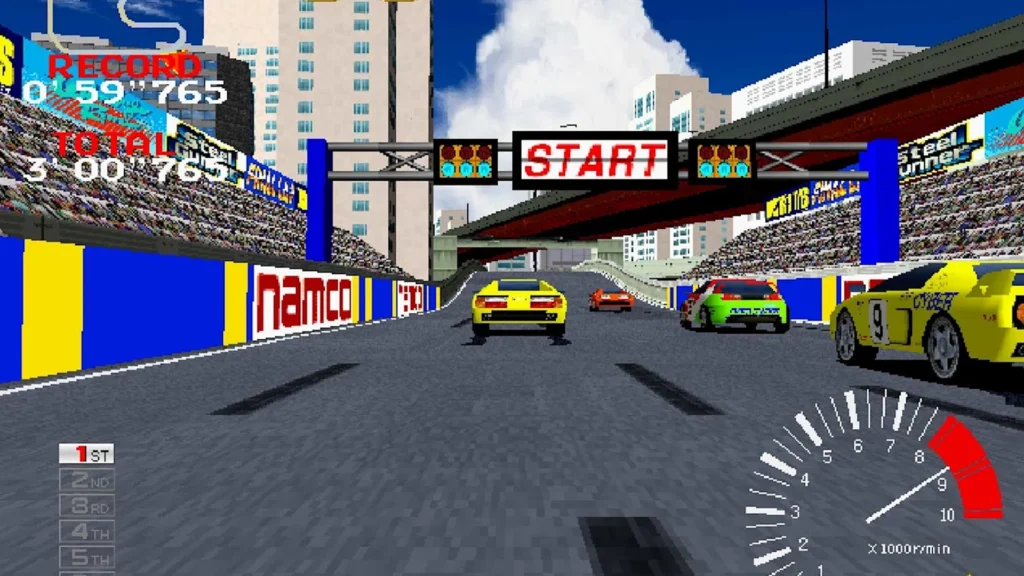
When it came to home consoles, Ridge Racer became the crown jewel of the original PlayStation’s launch lineup. It was the game you showed your friends to prove what 3D hardware could do. The high-energy soundtrack, neon-lit courses, and pick-up-and-play intensity all became defining traits of Namco’s identity throughout the ’90s.
Its influence didn’t end at the arcade. Need for Speed, Burnout, and countless other franchises would carry Ridge Racer’s DNA into the next decades. Even now, its drifting physics, checkpoint pacing, and time attack modes echo through nearly every modern racing game.
For many, Ridge Racer wasn’t just a game, it was the spark that lit the engines of an entire genre. Thirty-two years later, its tire marks are still visible on every racing track that dares to call itself an arcade racer.
The arcade original recently returned as part of Arcade Archives 2: Ridge Racer on PlayStation 5 and Nintendo Switch 2, complete with upgraded visuals, a redesigned UI, and new features like Time Attack mode, Variable Refresh Rate (VRR) support, and multiple save slots. The rerelease series also includes titles like Air Combat 22, Gee Bee, and Aqua Jet, bringing Namco’s arcade legacy to modern consoles.
Related Posts
- Save Point: This Day in Video Game History — Tactics Ogre
- Nostalgia Is the Real Final Boss – Why Remakes Are A Dime A Dozen
- Deus Ex Remastered Coming February 2026 With Modern Upgrades
- Bandai Namco’s Summer Showcase: Fighting, Frights, and Fan Service
